
Your Equipment Is Costing You More Than You Think (And Your Reports Don't Show It)
The Spreadsheet That Lied
Sophia runs a photography studio in Melbourne. Eight cameras, fourteen lenses, lighting rigs, backdrops, a drone she uses twice a year, and a van that hauls everything to location shoots. She tracks all of it in a spreadsheet her accountant set up in 2021.
Last October, she quoted a corporate client for a two-day product shoot. The quote looked solid — day rates, her time, an assistant, post-production. The job came in, she delivered it, the client paid. Three weeks later, her accountant called to say the job had actually lost money. The camera body she used needed a $900 sensor clean and calibration right after the shoot — a service that was overdue by four months. The drone's insurance renewal had lapsed. And the depreciation on the lighting kit she'd bought specifically for that style of work had never been factored into her day rate at all.
None of that was in the spreadsheet. The spreadsheet just listed what she owned.
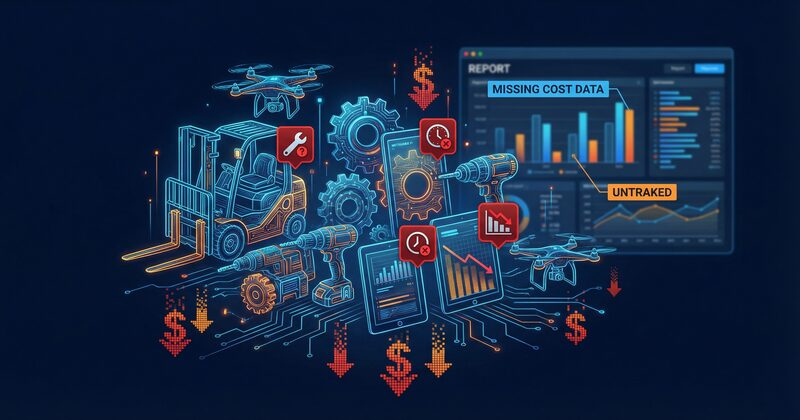
This is the quiet problem with physical assets in small businesses. It's not that owners don't care about their equipment — most care deeply, because the equipment *is* the craft. It's that the systems they use to track assets are completely disconnected from the systems that track money. And the gap between those two things is where profit quietly disappears.
The Invisible Admin Tax on Physical Assets
If you've read anything about running a healthy business, you've probably come across the idea that your time divides into three buckets: doing the actual work (craft), finding new clients and revenue (business development), and the administrative overhead that holds everything together. In a well-run business, admin sits at around 20% of your time. When it creeps past 35%, then 50%, you start to feel it — less time on craft, less energy for sales, more time chasing paperwork.
Equipment management is one of the sneakiest contributors to that admin creep, because it doesn't feel like admin. Booking a service for the commercial espresso machine feels like maintaining the café. Checking whether the physio clinic's ultrasound device is due for calibration feels like clinical governance. Figuring out which gym equipment is allocated to the personal training floor versus the group fitness room feels like operations. But all of it is administration — and when it's done manually, across spreadsheets and calendar reminders and sticky notes, it compounds.
Missed maintenance creates emergency repairs. Emergency repairs create unplanned costs. Unplanned costs don't appear in project quotes. Projects become less profitable than they looked. You quote the next job the same way and wonder why the margins never quite land where you expected.
Three Businesses, Three Versions of the Same Problem
The Gym That Couldn't See Its Own Costs
A mid-sized gym in Brisbane — thirty-plus pieces of cardio equipment, a full free weights section, cable machines, a reformer Pilates studio — had a maintenance spreadsheet managed by the floor supervisor. Services were logged when they happened. Breakdowns were noted. But the spreadsheet lived on a shared drive that the owners rarely opened, and it had no connection to the gym's accounting software.
When one of the treadmills needed a $2,400 motor replacement, it was logged as a repair expense under a catch-all "maintenance" category in Xero. Nobody connected it to the fact that the treadmill had missed two scheduled services in the previous eighteen months. Nobody calculated that the machine had been allocated to the high-intensity zone — the highest-traffic area — without any adjustment to its service frequency. And nobody noticed that three other treadmills in the same zone were on the same missed-service trajectory.
The owners knew they spent money on maintenance. They didn't know *which* equipment was costing them, *why*, or whether it was preventable. Their P&L showed a maintenance line. It didn't show a story.
The Restaurant That Quoted Without Its Kitchen
A catering company in Sydney — the kind that handles corporate events, private dinners, and the occasional wedding — owns a significant amount of kitchen equipment: commercial ovens, blast chillers, induction cooktops, chafing equipment, van refrigeration units. When quoting events, the owner factored in food costs, staff hours, and venue logistics. Equipment costs were essentially invisible in the quote.
The problem surfaced during a busy December. Two events ran back-to-back over a long weekend. The blast chiller that was supposed to be at Event B was still at Event A's venue when the team arrived to set up. The van refrigeration unit had a fault that nobody had logged because the driver who noticed it assumed someone else would report it. A $6,000 event almost had to be cancelled because the asset tracking system — a whiteboard in the prep kitchen — couldn't tell anyone where anything was or what condition it was in.
Beyond the operational chaos, the deeper issue was financial. None of the equipment's running costs, depreciation, or maintenance history was feeding into the event quotes. The business was essentially subsidising every event with invisible capital expenditure.
The Physio Clinic With a Compliance Blind Spot
A physiotherapy clinic in Adelaide runs a range of therapeutic devices: ultrasound machines, TENS units, shockwave therapy equipment, hydrotherapy gear. In Australia, therapeutic devices used in clinical settings have calibration and compliance requirements. The clinic tracked these in a shared calendar — a different calendar from the one used for patient appointments, and a different system again from their practice management software.
One of the ultrasound machines had a calibration certificate that expired in August. The calendar reminder went to a staff member who had left in July. Nobody noticed until an accreditation review in November flagged it. The machine had been used on patients for three months with an expired certificate. The administrative scramble that followed — emergency calibration, documentation, a written response to the accreditation body — cost the clinic principal two full days of clinical time.
Two days of clinical time, in a practice that bills by the hour, is not a small number. And it was entirely preventable.
What Asset Tracking Actually Needs to Do
These three businesses — a gym, a catering company, a physio clinic — have nothing obvious in common. But they share the same gap: their physical assets exist in a separate world from their financial data.
Useful asset tracking isn't just a list of what you own. It needs to do several things at once:
- Know where assets are: which project, which site, which staff member, which client engagement
- Know what condition they're in: last service date, next service due, any outstanding faults
- Know what they cost to run: not just purchase price, but maintenance history, repair costs, depreciation over time
- Connect to financial reports: so when a piece of equipment is allocated to a job, its cost appears in that job's P&L
- Alert before things go wrong: maintenance reminders that go to the right people, not a calendar that depends on someone remembering to check it
The last two points are where most small business asset systems fall completely flat. Tracking assets in isolation is better than nothing. But if that data never flows into your financial reports, you're still flying blind on profitability.
When Equipment Costs Flow Into Project P&L
Here's what changes when asset tracking is connected to your financial data.
Sophia, the photographer, quotes a two-day product shoot. When she assigns her primary camera body and the lighting kit to that project, the system knows the depreciation rate on both pieces of equipment and adds a cost allocation to the job. It also knows the camera is due for a sensor clean in six weeks — so it flags that upcoming cost before she finalises the quote, not after the job is done.
The gym owner in Brisbane sets up a maintenance schedule for each piece of cardio equipment, with service intervals based on usage zones. When a treadmill service is completed, the cost is logged against that asset. Over time, the reporting shows cost-per-machine, flags equipment that's costing disproportionately more than its peers, and makes the case for replacement before a $2,400 motor failure makes it for you.
The catering company in Sydney allocates equipment to each event in the same system where they manage the event budget. The blast chiller has a location status — at venue, in transit, in storage — so the team can see in real time what's available for the next booking. The van refrigeration fault gets logged by the driver through the same system, creating a maintenance task that someone actually owns.
The physio clinic sets calibration schedules for every therapeutic device. Reminders go to the clinic manager, not to individual staff members who might leave. The compliance documentation lives in the same place as the asset record, not in a separate folder on a shared drive.
None of this is exotic. It's just what happens when your asset tracking and your financial systems share the same data.
The Single Database Difference
Most businesses that try to solve this problem end up with two separate tools — an asset management app and an accounting platform — connected by an integration that syncs data on a schedule. This works, until it doesn't. The sync breaks. Someone updates an asset record in one system and the change doesn't carry across. A cost gets categorised differently in each system. The reports from the two tools tell slightly different stories, and you spend time reconciling them instead of reading them.
Opus takes a different approach. Projects, equipment, finances, timesheets, and client records all live in one database. When you allocate a piece of equipment to a project, the cost doesn't need to be synced anywhere — it's already part of the project record. When you log a maintenance expense against an asset, it flows into your P&L without a manual step. When you pull a profitability report for a job, the equipment costs are already in there.
This matters most for businesses where equipment is central to the work — hire companies, trade businesses, medical and allied health practices, event companies, creative studios, gyms and fitness facilities, restaurants and caterers. In any of these, the gap between "what we own" and "what it costs us" is where margin quietly leaks.
The Compliance Piece
For businesses in regulated industries — health, food service, electrical, any trade requiring licensed equipment — asset tracking also carries a compliance dimension that spreadsheets handle badly.
Calibration certificates expire. Safety inspections come due. Warranties require evidence of regular servicing to remain valid. When this information lives in a spreadsheet, it depends entirely on someone remembering to check it. When it lives in a system that generates reminders and stores documentation against the asset record, the compliance burden shifts from memory to process.
This isn't just about avoiding the kind of accreditation problem the physio clinic faced. It's about being able to demonstrate compliance quickly when you need to — for an insurance claim, a client audit, a regulatory inspection. Having the records is one thing. Having them organised and retrievable in under two minutes is another.
Depreciation You Can Actually See
One more thing that spreadsheets almost never capture properly: depreciation as a real, visible cost in project economics.
Most small business owners know their equipment depreciates. They see it on their tax return. But they rarely factor depreciation into job quotes, because the depreciation data lives in their accounting software and the quoting happens in a different system entirely.
When equipment records carry a purchase price, a useful life estimate, and a depreciation method, that information can flow into project cost calculations. A photographer who knows their camera body depreciates at roughly $80 per month can build that into their day rate. A gym that knows a treadmill has a seven-year useful life can plan its replacement cycle rather than being surprised by it. A hire company can price jobs knowing the true cost of the asset, not just the maintenance and fuel.
This is the difference between equipment management as an administrative task and equipment management as a financial tool.
Getting Started Without Overhauling Everything
If you're currently managing assets in a spreadsheet, the path forward doesn't require ripping everything out at once. Start with the assets that matter most — the ones that are central to your revenue, the ones with compliance requirements, or the ones with the highest maintenance costs. Build out the records for those first: purchase date, purchase price, service schedule, assigned location or project.
Then connect those records to your financial reporting. Even if you only do this for your top ten assets, you'll start to see costs that were previously invisible. You'll start quoting jobs with a more complete picture of what they actually cost to deliver.
Physical assets are how many businesses do their work. They deserve a tracking system that's as serious as the work itself — one that doesn't just list what you own, but tells you what it costs, where it is, when it needs attention, and how it's affecting your bottom line.
If that sounds like the kind of visibility your business is missing, it's worth taking a look at how Opus handles equipment management alongside everything else. You can explore the platform at [opus.net.au](https://opus.net.au).