
The Business Triangle: Why Every Business Owner Fights the Same Three-Way Battle
The Moment You Recognise the Pattern
You started your business because you were good at something. Maybe you're a brilliant architect, a gifted consultant, a talented developer, a passionate restaurateur, or an expert tradesperson. You had a craft, and you wanted to build something around it.
In the early days, you spent most of your time doing that craft. Eighty percent of your week was the work itself — designing, consulting, building, creating. The other twenty percent was everything else: sending invoices, answering emails, chasing leads, updating spreadsheets.
Then the business grew. And something shifted.
It happened so gradually you didn't notice. The spreadsheets multiplied. The tools proliferated. The emails became a torrent. The compliance requirements stacked up. Your bookkeeper needed more hours. Your project management system needed feeding. Your CRM needed updating. Your team needed onboarding into six different platforms.
One day, you look up from your desk and realise: you haven't done the actual work — the craft — in two weeks. You've been drowning in administration. And the business you built to do what you love has become a full-time job doing what you don't.
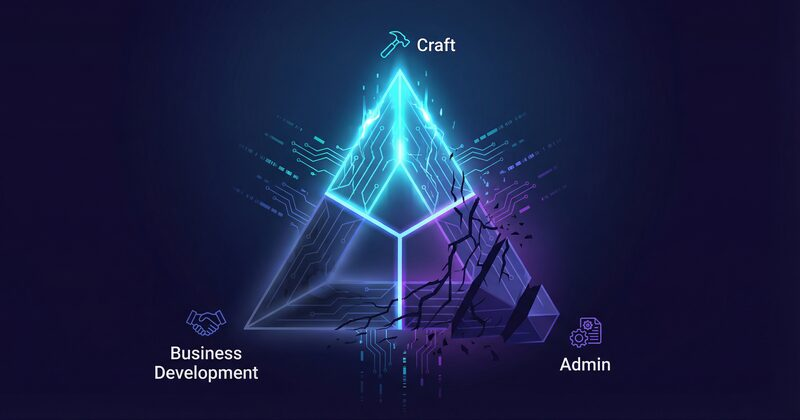
This isn't a personal failure. It's a structural one. And it has a name: the Business Triangle.
The Three Sides of Every Business
Every business, regardless of industry, size, or model, operates within three fundamental domains:
The Craft
This is the core competency — the thing the business exists to deliver. For an engineering firm, it's engineering. For a marketing agency, it's campaigns. For a SaaS company, it's building product. For a retailer, it's curating and selling goods. For a consultant, it's delivering expert advice. For a café owner, it's the food and the experience.
The Craft is what generates value for clients and customers. It's the reason people pay you. It's usually the reason the founder started the business, and it's the work that keeps the best employees engaged and fulfilled.
Business Development
This encompasses everything that brings new work through the door: sales, marketing, networking, proposals, pitches, lead nurturing, content creation, partnerships, and reputation building. Without Business Development, the pipeline dries up, revenue shrinks, and even the best craft in the world goes unnoticed.
Business Development is where growth lives. It's forward-looking, proactive, and revenue-generating. Every hour invested here has the potential to create future income.
Administration
This is everything else. Invoicing. Payroll. Compliance. Data entry. Tool management. Reconciliation. Contract paperwork. Tax filings. HR processes. Software updates. Integration debugging. Meeting scheduling. Report generation. Expense categorisation. Document filing. Password management. Subscription tracking.
Administration keeps the business legal, operational, and organised. It's necessary. But here's the critical insight: administration generates exactly zero revenue. Not one dollar of income has ever been produced by reconciling a bank feed, entering a timesheet into a second system, or debugging a Zapier connection.
The Death Spiral: How Admin Eats Your Business
In a healthy business, the triangle looks roughly like this:
- The Craft: : 50–60% of time
- Business Development: : 25–30% of time
- Administration: : 10–15% of time
But here's what actually happens as businesses grow, particularly businesses that adopt the "best-of-breed" approach to software:
Stage 1: The Innocent Addition (Year 1–2)
The business starts with minimal tools. Maybe Xero for accounting, email for communication, and a spreadsheet for project tracking. Admin sits at a manageable 15%.
Then a problem appears: "We need a proper CRM." HubSpot gets added. Now there are two systems to maintain, and client data exists in two places. Admin creeps to 20%.
Stage 2: The Tool Creep (Year 2–3)
The team grows. You need project management — Monday.com or Asana joins the stack. Time tracking requires Harvest. Team communication moves to Slack. Document storage goes to SharePoint or Google Drive. Each tool solves a genuine problem. Each tool also adds a login, a learning curve, a data silo, and maintenance overhead.
Now you need Zapier to connect them. That's another subscription and another failure point. Someone becomes the unofficial "integrations person" — fixing broken automations and debugging data mismatches between systems.
Admin is now 30% of everyone's week, though nobody has measured it because the cost is distributed across micro-tasks: five minutes here entering a client in HubSpot, three minutes there updating a timesheet in Harvest, ten minutes searching Slack for a conversation that might have been in email.
Stage 3: The Squeeze (Year 3–5)
The admin burden is now visible. The founder — the person whose Craft built the business — is spending more than half their time on operational tasks. Business Development suffers because there's no time for it. New client acquisition slows. Revenue plateaus.
The team feels it too. Project managers spend more time updating tools than managing projects. Delivery staff are pulled into admin tasks. Morale drops because people didn't take these jobs to do data entry across six platforms.
The triangle has inverted:
- Administration: : 50–55% of time
- The Craft: : 25–30% of time
- Business Development: : 15–20% of time
This is the death spiral. Admin has consumed the time that should be generating revenue (Business Development) and delivering value (The Craft). The business is working harder than ever but growing slower because the productive capacity has been eaten by operational overhead.
Stage 4: The Stall (Year 5+)
Growth stops. Not because the market dried up or the craft deteriorated — but because the business can't execute at scale. Every new client adds more admin. Every new project adds more coordination overhead. Every new team member needs to be trained on a dozen tools.
The founder considers hiring an operations manager to handle the admin. But that's an $80,000–$120,000 salary to treat the symptom, not the cause. The cause is architectural: too many disconnected systems creating too much manual work.
Some businesses never escape this stage. They stay at the same size for years, working furiously, unable to grow because every unit of growth generates more than a unit of overhead.
This Isn't Just Construction. This Is Every Business.
The Business Triangle is universal. It applies to:
Consultants and professional services firms: The Craft is expert advice. Admin is proposals, invoicing, timesheets, and compliance. The more clients you win, the more admin you generate.
SaaS and product companies: The Craft is building product. Admin is subscription management, customer onboarding paperwork, usage tracking, and support ticket routing. Scale brings more customers and more operational complexity.
Marketing and creative agencies: The Craft is campaigns and content. Admin is client reporting, time tracking, media buying reconciliation, and scope management. Every client adds another reporting cadence.
Retail businesses: The Craft is product curation and customer experience. Admin is inventory management, supplier invoicing, staff rostering, and compliance. More locations mean exponentially more admin.
Subscription businesses: The Craft is delivering ongoing value. Admin is billing management, churn analysis, feature usage tracking, and renewal processing. The recurring model means recurring admin.
Trades and field services: The Craft is on-site work. Admin is quoting, invoicing, scheduling, compliance certificates, and equipment maintenance tracking. Every job generates a paperwork tail.
E-commerce businesses: The Craft is sourcing products and creating a buying experience. Admin is order fulfilment tracking, returns processing, supplier reconciliation, and marketplace compliance. Every sales channel adds another layer.
The industries differ. The pattern doesn't.
The Software Paradox
Here's the cruel irony: most businesses adopt software specifically to reduce admin. They sign up for project management tools to get organised, CRMs to track clients, and communication platforms to stay connected. Each tool, individually, delivers on its promise.
But collectively, the tools create more admin than they eliminate.
Every tool requires:
- Setup and configuration: (hours, sometimes days)
- Data entry: (often duplicating what exists elsewhere)
- Learning and training: (for every team member)
- Ongoing maintenance: (updates, permission changes, integration fixes)
- Context switching: (23 minutes of lost focus per switch, per the UC Irvine study)
- Subscription management: (another invoice, another renewal, another vendor relationship)
A business running 8 tools has 28 potential integration pathways between them (n × (n−1) / 2). Even if each integration works 95% of the time, the probability of at least one failing on any given day is significant. And when an integration fails silently — which is how they usually fail — the resulting data inconsistency can go undetected for weeks.
The software was supposed to reduce admin. Instead, it created a new category of admin: tool management. Your team now spends time managing the tools that were supposed to save them time. It's a recursive trap that tightens with every new subscription.
Breaking the Spiral: Consolidation as Strategy
The solution isn't fewer tools for the sake of minimalism. It's fewer boundaries between systems, because every boundary creates friction and friction creates admin.
When projects, finances, clients, communications, and team management share a single database:
- Data entry happens once.: A client created in one context exists everywhere. An expense logged against a project flows directly to financial reporting. A timesheet entry automatically updates project costing.
- Context switching drops to near zero.: Moving from a project to its finances to its client history to its team chat doesn't require changing applications. It's one interface, one mental model, one set of navigation patterns.
- Integration maintenance disappears.: There's nothing to integrate because there's nothing to bridge between. No Zapier. No webhooks. No sync cycles. No silent failures.
- Training collapses.: One interface, one login, one set of permissions. New hires learn one system, not twelve.
- Reporting becomes instant.: When all data lives in one database, any question — "Which clients are most profitable?", "Which projects are over budget?", "Who has capacity this week?" — is answerable in seconds, not days.
The result is that admin drops from 55% back to where it belongs: 10–15%. And the 40% reclaimed goes back to The Craft and Business Development — the sides of the triangle that actually generate revenue and deliver value.
Measuring Your Own Triangle
Want to know where your business sits? Here's a practical exercise.
For one week, track how every person in your team (including yourself) spends their time, categorised into three buckets:
- Craft hours: Time spent directly on client-deliverable work or product development
- Business Development hours: Time spent on sales, marketing, networking, proposals, and growth activities
- Admin hours: Time spent on invoicing, data entry, tool management, reporting, internal coordination, compliance paperwork, and anything that doesn't fall into the first two categories
Be honest. Include the five minutes spent re-entering a client into Xero after creating them in the CRM. Include the ten minutes searching Slack for a project decision. Include the twenty minutes reconciling timesheets with project records. Include the fifteen minutes figuring out why the Zapier automation stopped syncing contacts last Tuesday.
Most businesses are shocked by the results. What feels like 20% admin turns out to be 40–50% when every micro-task is counted.
Now calculate the cost. Take each person's loaded hourly rate (salary plus super plus overheads) and multiply by their admin hours. For a 15-person business paying an average loaded cost of $75/hour, if admin consumes 20 hours per person per week, that's $1,125 per person per week — or $877,500 per year — spent on work that generates no revenue.
That number is not theoretical. It's the real cost of a fragmented operating environment. And it's the savings available to any business that consolidates its operations onto a unified platform.
The Reclaimed Triangle
A business that crushes its admin overhead doesn't just save money. It fundamentally changes what's possible.
When the founder reclaims 15 hours a week from admin, they can spend that time on the craft that made their reputation — or on the business development that drives growth. When project managers stop wrestling spreadsheets and start managing projects, delivery quality improves. When team members stop entering the same data into five systems, they have time for the work they were actually hired to do.
The healthiest businesses we see have their triangle looking like this:
- The Craft: : 55–65% of time
- Business Development: : 25–30% of time
- Administration: : 10–15% of time
They're not doing less admin. They're doing the same admin in a fraction of the time because their systems are unified. The compliance still gets done. The invoices still get sent. The data still gets tracked. It just happens in one system instead of twelve, with one data entry instead of four, and with automation handling the repetitive tasks that used to consume hours.
The reclaimed time doesn't just improve margins — it changes the trajectory of the business. More time on craft means higher quality work, which drives reputation, which drives referrals. More time on business development means a fuller pipeline, which drives revenue, which enables hiring, which creates capacity for more craft. The virtuous cycle is the mirror image of the death spiral, and it starts the moment admin gets compressed.
The Choice
Every business owner faces the same fork in the road, usually without realising it:
Path A: Continue adding best-of-breed tools as new problems arise. Accept that each tool comes with admin overhead. Watch the triangle slowly invert. Compensate by working harder, hiring more operations staff, or accepting slower growth.
Path B: Consolidate onto a unified platform that eliminates boundaries between business functions. Accept the upfront effort of migration. Reclaim the 40% of your team's time currently lost to admin. Reinvest that time in craft and growth.
Path A is the default. It happens automatically, one subscription at a time, one "free trial" at a time, one "we just need a quick fix for this" at a time. Nobody chooses the death spiral. They drift into it.
Path B is a deliberate choice — and it's the choice that separates businesses that plateau from businesses that scale.
The Business Triangle isn't a theory. It's the daily reality of every business owner who started a company to do great work and found themselves buried in admin instead. Understanding it is the first step. Acting on it is the one that actually changes the numbers.