
All-in-One vs Best-of-Breed: The Real Cost of Your Business Software Stack
The Debate That Defines Modern Business Operations
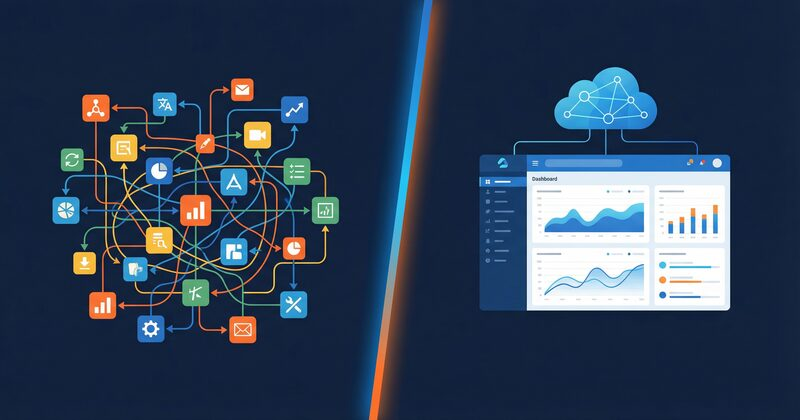
In every business technology discussion, the same argument eventually surfaces: should you pick the best individual tool for each function (best-of-breed), or should you consolidate onto one platform that does everything (all-in-one)?
The best-of-breed camp argues that specialised tools outperform generalists. Salesforce is better at CRM than a CRM module inside a project tool. Asana is better at project management than a task list tacked onto an accounting system. Slack is better at communication than a chat feature bolted into a business suite.
They're not wrong. Individually, specialised tools are often more polished, more feature-rich, and more refined in their specific domain.
But individually is the wrong frame. Businesses don't use tools individually. They use them together. And it's in the "together" where the best-of-breed approach falls apart — quietly, expensively, and with compounding consequences that most businesses never calculate.
The Hidden Costs Nobody Calculates
When a business evaluates software, the analysis almost always stops at subscription fees and feature checklists. What gets ignored are the systemic costs — the overhead generated not by any single tool but by the interactions between tools.
Cost 1: Context Switching — The 23-Minute Tax
Let's start with the most well-documented hidden cost. A study from the University of California, Irvine established that it takes an average of 23 minutes and 15 seconds to return to full productive focus after a task interruption. Switching from Asana to Xero to Slack registers in your brain as three separate environment changes, each requiring cognitive reorientation.
For a 20-person team, let's be conservative. Assume each person switches between applications 25 times per day (most studies suggest it's higher) and that each switch costs an average of 5 minutes of reduced productivity (far less than the full 23-minute figure). That's 125 minutes per person per day — over two hours lost to context switching.
Across the team: 20 people × 125 minutes = 2,500 minutes per day = 41.7 hours per day.
At a loaded cost of $70 per hour (including salary, super, and overheads for an Australian business), that's $2,917 per day in lost productivity from context switching alone. Over a working year of 250 days: $729,250.
You read that correctly. For a 20-person business, context switching between best-of-breed tools costs more than three-quarters of a million dollars per year in lost productivity. Even halving the estimate leaves you with a staggering figure that dwarfs the subscription costs.
Cost 2: Duplicate Data Entry — The Error Factory
In a best-of-breed environment, the same information gets entered into multiple systems. A new client is created in the CRM, the accounting system, the project management tool, and the document management system. A new project is set up in the PM tool and manually mirrored in the financial tracking system.
Each re-entry takes time: typically 3–5 minutes per data point per system. More importantly, each re-entry introduces error risk. Names get misspelled. Phone numbers get transposed. Tax codes get misapplied. These errors are small individually but compound over time, degrading data quality across the entire tool stack.
For a business processing 50 new projects and 200 new contacts per year across 4 systems, that's 1,000 data entry events that should have been 250. At an average of 4 minutes per entry, that's 50 hours of pure waste — before counting the time spent finding and correcting the errors those entries inevitably produce.
The downstream cost of data errors is harder to quantify but often larger. An invoice sent to the wrong email address delays payment by 30 days. A project budgeted with incorrect cost codes produces misleading profitability reports. A client record with the wrong contact person results in missed communication and damaged relationships.
Cost 3: Integration Maintenance — The Invisible IT Department
Best-of-breed stacks require integrations. Zapier, Make (formerly Integromat), custom APIs, and CSV imports are the connective tissue that holds the stack together.
These integrations work — most of the time. But each one is a fragile connection between two systems with independent release schedules, independent API changes, and independent reliability characteristics. When one side changes — a new API version, a modified data format, a rate limit adjustment — the integration breaks.
Broken integrations often fail silently. Data stops flowing between systems, and nobody notices until the consequences surface: invoices not created, contacts not synced, project costs not updated. By the time the break is discovered, the resulting data inconsistency may require hours of manual reconciliation.
For a 20-person business running 10 tools with 15 active integrations:
- Zapier/Make subscription: $100–$300/month = $1,200–$3,600/year
- Time spent monitoring integrations: 2 hours/week = $7,280/year
- Time spent fixing broken integrations: average 4 hours/month = $3,360/year
- Time spent reconciling data after integration failures: average 6 hours/month = $5,040/year
Total integration maintenance cost: $16,880–$19,280/year
This is work that produces zero business value. It exists only because the tools that were supposed to save time can't talk to each other natively.
Cost 4: Training Overhead — The Never-Ending Onboarding
Every tool in the stack has its own interface paradigm, its own navigation patterns, its own keyboard shortcuts, and its own mobile app. A new hire at a business running 10 tools needs to learn 10 different environments.
The initial training cost is significant: 2–3 hours per tool × 10 tools = 20–30 hours of onboarding per new hire, just for software orientation. At a loaded cost of $70/hour, that's $1,400–$2,100 per new hire before they've done a single productive task.
But the ongoing cost is worse. Every time a tool updates its interface — and SaaS tools update frequently — the entire team experiences friction. The button moved. The menu changed. The report is in a different section. Each disruption is small. Multiplied across 10 tools and 20 users, the cumulative impact is substantial.
Cost 5: Decision Latency — The Strategic Cost
This is the cost that never appears on any spreadsheet but may be the most significant of all.
When your data lives in 10 separate systems, answering a cross-functional business question requires assembling information from multiple sources. "Which clients are most profitable?" requires revenue data from Xero, project cost data from Harvest, and sales cost data from HubSpot. Assembling this picture takes hours or days.
By the time the answer arrives, the decision window may have closed. A project that's bleeding money doesn't get course-corrected in week two — it gets discovered in the month-end report when the damage is already done. A client showing warning signs of disengagement doesn't get a proactive call — the pattern isn't visible until they've already left.
Speed of insight directly translates to quality of decisions. A business that can answer any operational question in seconds will consistently outmanoeuvre a business that needs days to assemble the same picture from scattered data.
The Total Cost of Best-of-Breed for a 20-Person Business
Let's add up the real cost:
| Cost Category | Annual Cost |
|---|---|
| Software subscriptions (10 tools) | $28,000–$45,000 |
| Context switching productivity loss | $729,250 |
| Duplicate data entry | $3,500 |
| Integration maintenance | $17,000–$19,000 |
| Training overhead (3 new hires/year) | $4,200–$6,300 |
| Decision latency (conservative estimate) | $20,000–$50,000 |
| **Total** | **$801,950–$852,550** |
Even if you halve the context switching estimate — arguing that the 5-minute-per-switch figure is too generous — you're still looking at over $400,000 per year in total cost of ownership for a fragmented tool stack.
The subscription fees that appear on the invoice? They represent about 5% of the real cost.
The Architecture That Changes the Equation
The all-in-one alternative isn't about compromise. It's about architecture.
The historic criticism of all-in-one platforms was valid: they were typically mediocre at everything. A CRM module built as an afterthought couldn't compete with Salesforce. A project management feature designed as a checkbox couldn't match Asana.
But the architecture of modern unified platforms has evolved. The key distinction is between bundled applications (separate tools wearing the same brand) and federated platforms (single-database systems where every function shares the same data layer).
Bundled Applications
A bundled suite is what you get when a company acquires or builds separate tools and puts them under one login. Salesforce with Slack, Atlassian with Jira and Confluence, Microsoft with its 365 suite — these are collections of distinct products with distinct databases, connected by internal sync mechanisms.
Bundled suites are better than fully disconnected stacks. You get one bill, one vendor, and some degree of data sharing. But the sync layer still exists, still breaks, and still creates data inconsistencies. You've moved the integration problem from your desk to the vendor's — which is an improvement, but not a solution.
Federated Platforms
A federated platform stores everything in a single database with a single data model. Projects, clients, finances, communications, timesheets, and equipment all reference the same underlying records. There is no sync layer because there is nothing to sync.
This architecture enables:
- Real-time cross-functional queries: : "Show me all projects for clients with overdue invoices" is a single database query, not a multi-system research exercise.
- Zero-lag automation: : When a project status changes, every related function — financial tracking, team notification, resource allocation — updates instantly because they're reading the same record.
- Native AI intelligence: : An AI assistant can query the entire business state in one pass because all data lives in one place.
- True single data entry: : Create a client once. The record serves the CRM, project management, invoicing, communication, and reporting without replication.
The Feature-Depth Objection
"But Asana has better Gantt charts." "But Salesforce has more CRM customisation." "But Slack has better integrations."
These objections are real. Specialised tools often have deeper features in their specific domain. But the question isn't whether Tool X has more features than Module X in a unified platform. The question is whether those extra features are worth the systemic costs of fragmentation.
For most SMEs, the answer is no. A project management module that covers 90% of Asana's functionality while connecting natively to financials, client records, and team communication delivers more total value than Asana at 100% plus the cost of disconnecting it from everything else.
The feature-depth objection also assumes that unified platforms are permanently less capable than specialists. This ignores the fact that unified platforms are investing heavily in every module. The gap narrows with every release, and for SME use cases — which rarely need the most advanced features of any category — the gap is already negligible.
The Decision Framework
Choose Best-of-Breed When:
- You have a 50+ person team with dedicated IT staff to manage integrations
- A specific function requires genuinely advanced capabilities that no unified platform offers (e.g., enterprise CRM customisation at Salesforce scale)
- Your business model is so specialised that no unified platform covers your requirements
- You have the budget and appetite for integration middleware and its ongoing maintenance
Choose a Unified Platform When:
- Your team is 5–50 people and doesn't have dedicated IT support
- Admin overhead is consuming more than 20% of your team's time
- You can't answer basic cross-functional business questions without spreadsheet gymnastics
- You're spending $15,000+ per year on tool subscriptions plus integration tools
- You want real-time visibility across projects, finances, and client relationships
- Your growth is constrained by operational complexity rather than market opportunity
For the vast majority of small and medium businesses, the second list is the reality. And for those businesses, the unified platform isn't a compromise — it's an upgrade.
Making the Transition
Switching from best-of-breed to a unified platform doesn't mean flipping a switch. It means phased migration:
- Start with the biggest pain point. If project-to-financial disconnection is your worst problem, start there. Migrate project management and enable the financial integration first.
- Add functions incrementally. Once the team is comfortable, bring in CRM, then communications, then timesheets. Each addition reduces the total tool count and eliminates one more integration.
- Keep what must be kept. Xero stays. Microsoft 365 stays. The unified platform doesn't replace everything — it replaces the operational middleware that was creating the most friction.
- Measure continuously. Track admin time, decision speed, and data accuracy at each stage. The improvement should be visible within 30 days of each phase.
The Bottom Line
The best-of-breed versus all-in-one debate has been framed as a trade-off between quality and convenience. In reality, it's a trade-off between feature depth in isolated categories and total business performance across all categories.
For a 20-person business, the real cost of best-of-breed isn't the $30,000–$45,000 in subscriptions. It's the $400,000–$800,000 in context switching, duplicate effort, integration maintenance, training overhead, and decision latency. That's the true price of picking the best tool for each job without considering how those tools work together.
A unified platform won't have the deepest Gantt chart or the most customisable CRM pipeline. But it will give you something no collection of best-of-breed tools can: a single, coherent picture of your entire business, updated in real time, accessible to everyone, and queryable by AI.
For most businesses, that's not a compromise. That's the whole point.